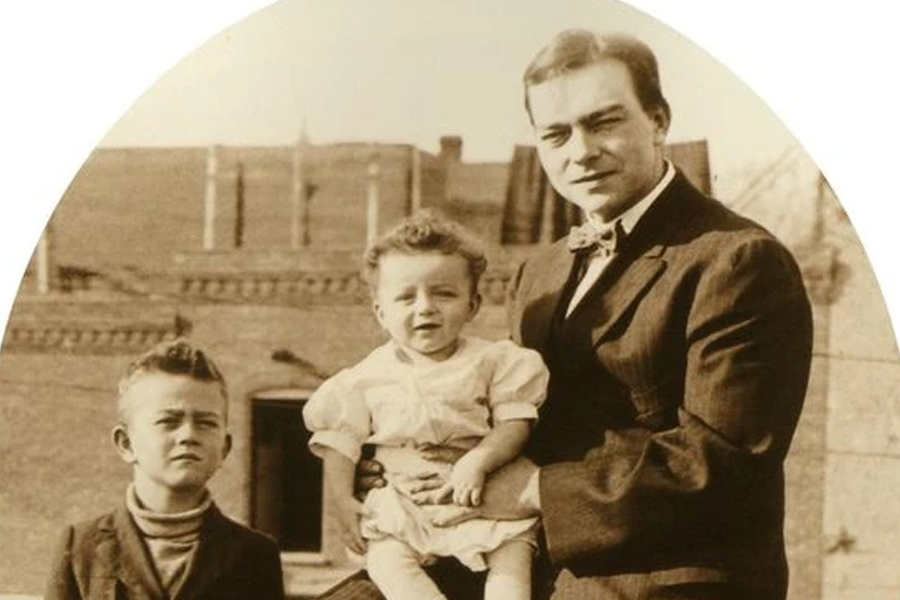
A Life Framed by Work, Family, and Movement
I think of Clyde Leonard Morrison as one of those people whose life sits just beneath the bright light of history, like a foundation stone hidden under a landmark. He was born on 20 August 1884, and the record places his early life in Illinois, though different accounts vary on the exact locality. That uncertainty does not lessen the shape of his story. It only reminds me that many family histories are stitched together from church books, census pages, obituaries, and memory.
Clyde became known as a pharmacist and drugstore owner, a practical profession with a steady rhythm. He lived in an era when a drugstore was more than a place to buy medicine. It was a neighborhood anchor, a place where people came for remedies, advice, and daily necessities. That setting fits Clyde well. His life seems to have been built on usefulness, routine, and responsibility rather than public display.
By the early 20th century, he was part of a family that would eventually become widely recognized because of his son John Wayne. Yet Clyde himself was not a celebrity. He was the man behind the man, the early current in a river that later became famous. That role matters. It shaped the household, the children, the work ethic, and the family memory that followed.
Marriage, Household, and the Shape of the Morrison Family
Clyde Leonard Morrison married Molly Brown on September 29, 1905, in Knoxville, Iowa. His marriage is his most significant domestic chapter. Mary Alberta Brown is his most important companion because they raised the Morrison children together.
They had two boys who were Clyde’s best-documented descendants. The first was Marion Robert Morrison, born 26 May 1907. Later, he became John Wayne, a famous American actor. Robert Emmett Morrison, born 18 December 1911, was the second son. Although Robert Emmett did not become a household name, he is nevertheless an important part of the family story.
After his first marriage dissolved, Clyde married Florence Rosetta Allen Morrison (Florence A. Morrison). Although Clyde and Florence did not have more children, this relationship enlarged the family again around 1930. His widow Florence is honored following his 1937 death. Her daughter Nancy Ellen married into the family. Because family life isn’t always linear, that detail matters. Children, stepchildren, and blended families often share a roof and years.
Parents, Siblings, and Earlier Generations
Every family tree has roots that disappear underground before rising into view again. Clyde’s parents were Marion Mitchell Morrison and Wealtha Chase Parsons. Their names place him inside a broader Midwestern family line that stretches back beyond the fame attached to his son. In records, Clyde appears among several children in that household, including George Henry Morrison, Guy Jasper Morrison, and Pearl Lynette Morrison.
I find this part of the story important because it gives Clyde context. He did not emerge from nowhere. He came from a family already moving through the ordinary struggles of American life in the late 19th century. His parents, siblings, and grandparents made the groundwork on which his own marriage and children later rested. In family history, this is often where the story becomes most human. Before there is fame, there is labor. Before the spotlight, there is inheritance.
Children, Grandchildren, and the Spread of the Morrison Name
Clyde’s children are the bridge between his private life and the public memory attached to his family.
Marion Robert Morrison, or John Wayne, became the family’s most famous figure. Born in 1907, he turned into a giant of film, a star whose image later became larger than life. But to me, he is also Clyde’s son, a child formed in a household shaped by pharmacy work, movement, and family discipline.
Robert Emmett Morrison, born in 1911, completed the picture of Clyde’s documented sons. He belongs in the story not as a shadow of John Wayne, but as a separate branch of the family tree. Every family has more than one story, and his name helps prevent the record from collapsing into celebrity alone.
Through John Wayne, the family line continued into the next generations. The grandchildren commonly identified in public family records include Michael Wayne, Mary Antonia Wayne LaCava, Patrick Wayne, Melinda Wayne Munoz, Aissa Wayne, John Ethan Wayne, and Marisa Wayne. These names show the widening rings of a family that began with a pharmacist in the Midwest and spread outward through later decades into new homes, marriages, and careers.
Some of those descendants continued the family line still further. Brendan Wayne appears among the great grandchildren, showing that Clyde’s legacy extended into later generations that still carry the Morrison name through memory, kinship, and public attention. This is how family history works. One life becomes several lives, then dozens, then more, each carrying a trace of the original source.
Career, Residence, and Daily Work
His life is reflected in his pharmacy job. Early 1900s pharmacists needed trust, precision, and constancy. He treated infirmities and anxieties. He managed substances, prescriptions, and community needs. That work needed patience and calmness.
By 1911, Clyde was in Glendale, California. This journey from Iowa to California is important because it symbolizes a greater early 20th-century American westward drive. Like travelers following a brilliant thread, families followed opportunity. Clyde’s employment and household changed in Glendale. John Wayne, Clyde’s son, remembers the family drugstore milieu in his childhood, making his job seem less abstract. It went beyond a title. The homey environment.
I consider his work peaceful architecture. He built stability one prescription and day at a time. This labor rarely makes headlines but keeps families together.
A Brief Timeline of Clyde Leonard Morrison
1905: He married Mary Alberta Brown in Knoxville, Iowa.
1907: His son Marion Robert Morrison, later John Wayne, was born.
1911: His son Robert Emmett Morrison was born.
1911: Records place Clyde as a pharmacist in Glendale, California.
1930: He later married Florence Rosetta Allen Morrison.
4 March 1937: He died in Beverly Hills, California.
That timeline is short, but it carries weight. It maps a life that moved from the Midwest to California and from family formation to legacy.
Family Members in Focus
| Family member | Relationship to Clyde Leonard Morrison | Notes |
|---|---|---|
| Marion Mitchell Morrison | Father | Part of Clyde’s earlier family foundation |
| Wealtha Chase Parsons | Mother | Mother of Clyde and his siblings |
| George Henry Morrison | Brother | Part of the Morrison sibling group |
| Guy Jasper Morrison | Brother | Part of the Morrison sibling group |
| Pearl Lynette Morrison | Sister | Part of the Morrison sibling group |
| Mary Alberta Brown | First spouse | Married Clyde in 1905 |
| Marion Robert Morrison, John Wayne | Son | Born 1907, actor and public figure |
| Robert Emmett Morrison | Son | Born 1911 |
| Florence Rosetta Allen Morrison | Second spouse | Later wife and widow |
| Nancy Ellen | Stepdaughter | Associated with Florence’s earlier family |
| Michael Wayne | Grandchild | Through John Wayne |
| Mary Antonia Wayne LaCava | Grandchild | Through John Wayne |
| Patrick Wayne | Grandchild | Through John Wayne |
| Melinda Wayne Munoz | Grandchild | Through John Wayne |
| Brendan Wayne | Great grandchild | Later generation |
FAQ
Who was Clyde Leonard Morrison?
Clyde Leonard Morrison was an American pharmacist and drugstore owner, and he is best remembered today as the father of John Wayne. His life connected ordinary work with an unusually prominent family legacy.
Who was Clyde Leonard Morrison married to?
He was first married to Mary Alberta Brown, also called Molly, and later to Florence Rosetta Allen Morrison.
How many children did Clyde Leonard Morrison have?
The best documented children are two sons, Marion Robert Morrison, later known as John Wayne, and Robert Emmett Morrison.
Where did Clyde Leonard Morrison live and work?
He was associated with Iowa early in life and later with Glendale, California, where he worked as a pharmacist and drugstore owner.
Why is Clyde Leonard Morrison historically important?
He matters because he stands at the root of one of America’s most recognizable family lines. He also represents the quieter history behind public fame, the kind built through work, marriage, migration, and parenthood.
When did Clyde Leonard Morrison die?
He died on 4 March 1937 in California.