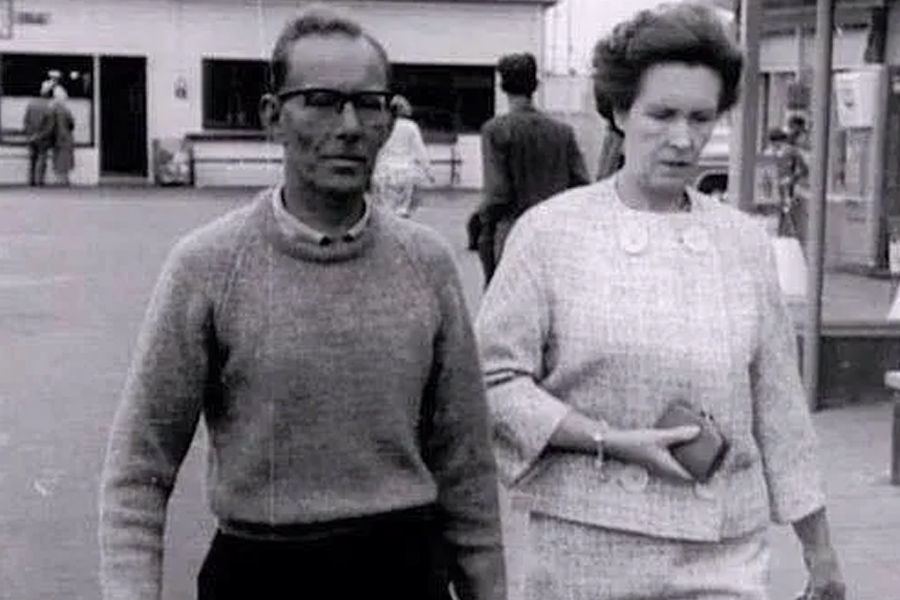
A name that sits in the shadow of fame
I find Haywood Stenton Jones fascinating because he is both central and obscure. He is central because he stands at the root of one of the most watched family lines in modern popular culture. He is obscure because the public remembers his son far more vividly than the man himself. Born on 21 November 1912 in Doncaster, Haywood lived through a century in miniature, moving from the world of Yorkshire trade and wartime loss into the orbit of music, reinvention, and global celebrity.
He is usually referred to as John Jones, but the fuller name, Haywood Stenton Jones, gives him a larger silhouette. It sounds formal, almost architectural, as though it belongs to a man built from old brick and weathered stone. Yet the life behind the name was human, complicated, and often indirect. He was a father, a husband twice over, a son of a wartime family, and a figure whose personal choices left long echoes through later generations.
Family roots and early life
Haywood came from a family shaped by work, loss, and resilience. His father was Robert Haywood Jones, associated with the boot trade, and his mother was Zillah Hannah Blackburn. Both parents died when Haywood was still young, leaving the family history marked by early absence. His sibling, Roma Jones, is the other name that appears consistently in the family record. That small circle of kin gives the impression of a family tree pruned hard by time.
Here is the family structure in its simplest form:
| Family member | Relationship to Haywood Stenton Jones | Notes |
|---|---|---|
| Robert Haywood Jones | Father | Boot trade background |
| Zillah Hannah Blackburn | Mother | Died young |
| Roma Jones | Sister | Haywood’s sibling |
| Hilda Louise Sullivan | First wife | Married in 1933 |
| Margaret Mary Burns Jones | Second wife | Married in 1947 |
| David Bowie | Son | Born 1947 |
| Annette | Daughter | Commonly linked to an earlier relationship |
| Terry Burns | Raised stepson | Peggy’s son from a previous relationship |
| Duncan Jones | Grandson | David Bowie’s son |
| Alexandria Zahra Jones | Granddaughter | David Bowie’s daughter |
| Stenton David Jones | Great-grandson | Later generation of the family line |
The family history is not a straight line but a braided river. Some branches are biological, some are social, and some are defined by care rather than blood. That complexity is part of Haywood’s story.
Marriage, fatherhood, and the domestic center
1933 saw Haywood marry Hilda Louise Sullivan. Their marriage ended in divorce. He married Margaret Mary (Peggy) in 1947 after his divorce was final. Peggy lived a rich life before joining this family. The Ritz Cinema waitress from Tunbridge Wells brought her background, children, and history into the marriage.
Layered home life surrounded Haywood. David Bowie was born on January 8, 1947, to Haywood and Peggy before their marriage. Haywood raised Peggy’s son Terry Burns as his own. The family didn’t look like a hall portrait. Years of rearranging made it look like a room with different dates and stories on each piece. Annette is part of the family narrative, usually set around 1941 and tied to a prior connection, though public stories differ.
My takeaway is that Haywood’s fatherhood was messy. He emerges as a man who balanced marriages, responsibilities, and domestic duties. That existence rarely makes headlines but shapes generations very invisibly.
Career and working life
Haywood’s career history is modest in the public record but still revealing. He worked as a promotions officer for Barnardo’s, and some accounts describe him as a club proprietor. That mix tells me something important: he was not simply a background figure. He moved between charity work, public-facing promotion, and local enterprise.
A promotions role at Barnardo’s suggests organization, persuasion, and social presentation. It means he was likely comfortable speaking to people, representing an institution, and making a case for support. The club proprietor detail, meanwhile, hints at a more local and entrepreneurial side, perhaps a life where business and community overlap. Together, the roles sketch a man who was practical, socially aware, and adaptable.
If I were to describe his career in one image, I would call it a bridge over two worlds. One side is postwar respectability and charity work. The other is the rougher, more improvisational world of club culture and independent business. Haywood seems to have stood on both banks.
The wider family legacy
His descendants make Haywood famous. One of the most influential 20th-century artists was his son David Bowie. Even after Haywood’s 1969 death, his fame spread.
Future generations continue the line. Duncan and Alexandria Zahra Jones, David Bowie’s children, are Haywood’s grandchildren. Stenton David Jones adds a generation and revitalizes the surname. This family has mirror-like names. Some are inherited, some repeated, and some seem chosen for memory as well as identification.
Repetition strikes me. Non-biological family lines exist. Linguistic. Haywood, Stenton, and Jones are passed down like coins. They carry weight from being carried.
A life measured by dates
Haywood’s life can be tracked through a few firm dates, and those dates create a clean arc:
1912, his birth in Doncaster.
1933, his marriage to Hilda Louise Sullivan.
1947, the year of David Bowie’s birth and his later marriage to Margaret Mary Burns.
1953, the move to Bromley, where family life became more settled.
1969, his death from pneumonia in Bromley at age 56.
Those dates do not tell the whole story, but they create the rhythm of it. The life begins in Edwardian Britain, moves through war and midcentury change, and ends before the full cultural explosion that his son would later embody. Haywood did not live to see the scale of David Bowie’s legacy. That absence gives his story a slightly ghosted quality. He is present in the roots, not the branches.
Why Haywood Stenton Jones matters
I think Haywood matters because he reminds us that fame always has a private foundation. Behind every public legend there is usually a household, a marriage, a job, a compromise, and a parent trying to make sense of the day. Haywood Stenton Jones was not a celebrity in his own right, but he was a man whose life connected work, family, and inheritance in a way that still draws attention.
His story is not dramatic in the usual sense. It does not hinge on scandals or grand public acts. Instead, it has the quieter force of a foundation stone. It supports, it shapes, and it is often hidden under the building that rises above it.
FAQ
Who was Haywood Stenton Jones?
Haywood Stenton Jones was the father of David Bowie. He was born in 1912, lived most of his life in England, worked in promotions for Barnardo’s, and is also described in some accounts as a club proprietor.
Was Haywood Stenton Jones always called by that name?
He was often called John Jones in public references. Haywood Stenton Jones is the fuller name attached to him in family and historical records.
Who were his family members?
His parents were Robert Haywood Jones and Zillah Hannah Blackburn. His sibling was Roma Jones. His wives were Hilda Louise Sullivan and Margaret Mary Burns Jones. His son was David Bowie. Other family members linked to the household include Annette and Terry Burns, and later descendants include Duncan Jones, Alexandria Zahra Jones, and Stenton David Jones.
What did he do for work?
He worked as a promotions officer for Barnardo’s. Some accounts also describe him as a club proprietor. His work suggests a mix of public communication, charity involvement, and local business activity.
When did he live?
He was born on 21 November 1912 and died on 5 August 1969. He was 56 years old when he died.
Why is he remembered today?
He is remembered because he was David Bowie’s father and because his family line remains part of Bowie’s broader public story. His life is also remembered through genealogy, archive materials, and family history discussions.
What makes his family story unusual?
The family structure is layered. There are two marriages, children from different relationships, a raised stepson, and several generations of descendants connected to one of the most famous musicians in the world. The result is a family story that feels less like a straight road and more like a branching tree in strong wind.